

Design principles in mechanical engineering: The comprehensive guide
Mst. Stefan PrimusOver 60 percent of all machine failures can be traced back to design flaws. Anyone working in mechanical engineering knows how much depends on proper planning. Design principles provide the foundation for durable, safe, and efficient technical solutions. This article explains why well-considered approaches to material selection, functional integration, and design for manufacturability not only enable innovative products but also sustainably reduce costs and risks.
Table of contents
- What are design principles?
- Understanding material and functional principles
- Leverage modularity and functional integration
- Ensure manufacturable design
- Consider economic efficiency, safety and sustainability
Key findings
| Point | Details |
|---|---|
| Design principles | Engineers must master fundamental methods for developing efficient and reliable technical systems. These principles include modularized and function-integrated approaches. |
| Material and functional principles | A deep understanding of material properties and their interactions with functional requirements is crucial for technical innovation. |
| Design for manufacturability | Designs should be geared from the outset towards economical manufacturability and resource conservation in order to minimize complexity. |
| Sustainability and economic efficiency | Modern design approaches must consider both economic efficiency and environmental friendliness in order to develop sustainable solutions. |
What are design principles?
Design principles are fundamental methods and strategies that engineers and designers in mechanical engineering use to systematically develop and design technical systems, machines, and machine parts. According to the Bundeswehr University Munich, these principles include the standards-compliant representation of machine parts, precise tolerance measurements, and the constructive design of complex mechanical systems.
The main objectives of design principles can be divided into several core aspects:
- Development of functional and efficient technical solutions
- Ensuring the reliability and performance of machines
- Optimization of manufacturing processes
- Reduction of production costs
- Ensuring safety and ergonomics
As Frankfurt University emphasizes in its examination regulations, prospective mechanical engineers must learn to apply these design principles to diverse tasks. This means not only technical knowledge, but also the ability to develop creative solutions for complex technical challenges.
Several methodological approaches play a crucial role in this process: systematic problem analysis, functional decomposition of technical systems, use of standardized design methods, and continuous optimization. Engineers must constantly find a balance between technical feasibility, economic efficiency, and practical implementation.Aluminum connectors are often a key element for the efficient connection and construction of technical systems.
Understanding material and functional principles
Material and functional principles form the foundation of every successful technical design in mechanical engineering. They describe the fundamental strategies for selecting materials and their optimal use in order to develop technical systems that are both functional and efficient.
The most important material principles include:
- Analysis of mechanical and physical properties
- Assessment of load-bearing capacity and strength
- Consideration of corrosion resistance
- Investigation of weight and density
- Assessment of machinability and deformability
In contrast, functional principles focus on the following aspects: the analysis of motion sequences, the transmission of forces, the minimization of energy losses, and ensuring smooth interaction between different machine components. In this context, aluminum profiles and their diverse applications play a crucial role in flexible and efficient design solutions.
For engineers, this means they must not only master the theoretical foundations but also develop a deep understanding of practical implementation and the interactions between materials and functions. The art of design lies in the intelligent combination of material properties and functional requirements to create innovative and high-performance technical systems.
Leverage modularity and functional integration
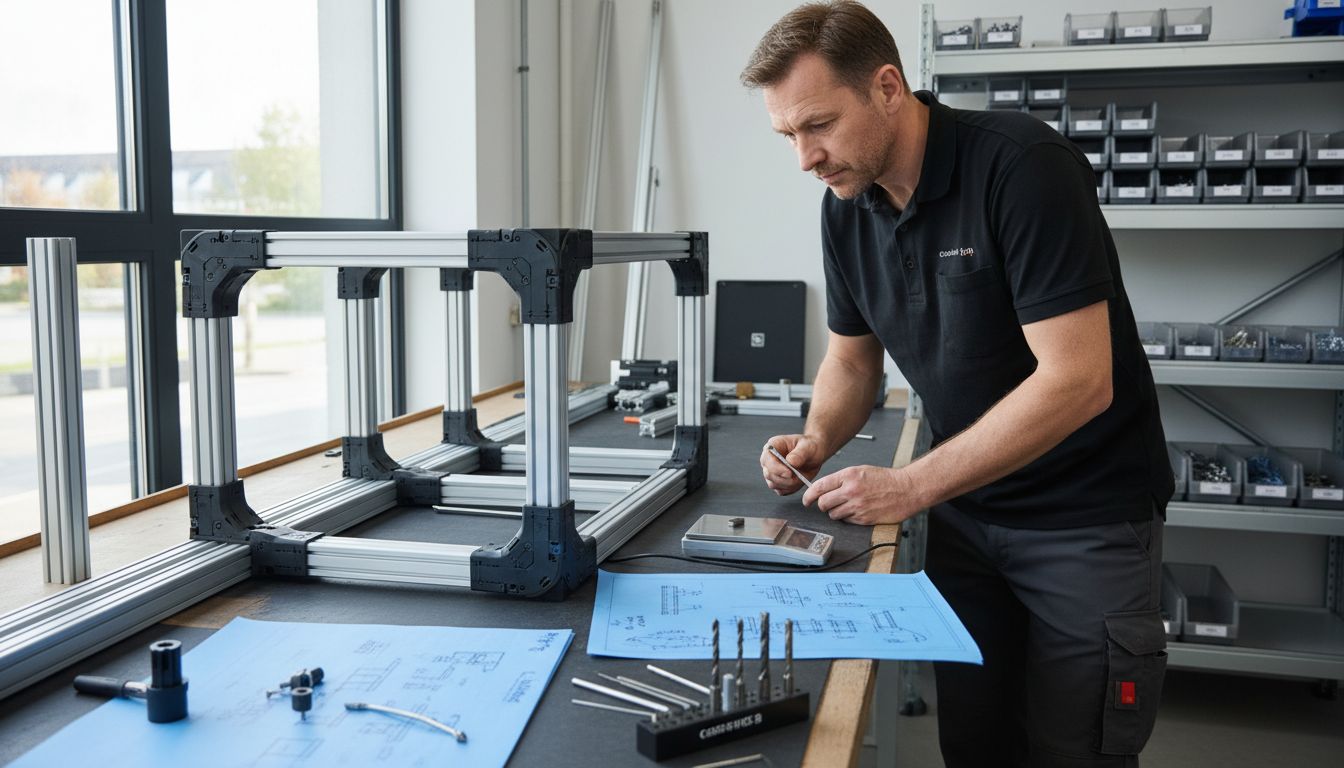
Modularity and functional integration are key strategies in modern mechanical engineering, enabling engineers to design complex technical systems more efficiently and flexibly. According to the Technical University of Munich, standardized design principles serve to reduce development effort and facilitate the onboarding of new employees.
The key aspects of modularity include:
- Decomposition of complex systems into standardized subcomponents
- Simplification of maintenance and replacement processes
- Increased flexibility in system adjustments
- Optimization of production costs
- Promoting the reusability of components
Functional integration involves combining multiple functions into a single component, thereby reducing system complexity. Flexible connectors for aluminum profiles, for example, demonstrate how modular solutions can simultaneously meet various mechanical requirements.
For engineers, this means thinking creatively and viewing design principles not as rigid rules, but as flexible tools. The key lies in intelligently combining standardization and innovation to develop technical solutions that are both economically and technically superior.
Ensure manufacturable design
Design for manufacturability is a crucial process in mechanical engineering, where technical solutions are designed to enable economical and efficient production. As Wikipedia describes, this involves the cost-effective manufacturing of workpieces, with design documents precisely defining shape, tolerances, surface roughness, and material.
The core aspects of a design suitable for manufacturing include:
- Minimizing manufacturing complexity
- Reduction of processing steps
- Optimization of material use and resource consumption
- Simplification of assembly processes
- Guarantee of consistent product quality
At this point, planning for precise substructures plays a crucial role in optimizing technical systems for manufacturability as early as the design phase. As the module handbook of Helmut Schmidt University emphasizes, mechanical and thermal loads must be systematically considered.
For engineers, design for manufacturability means more than just technical precision. It's about holistically considering and integrating economic, technical, and production-related aspects right from the planning phase. Success lies in the ability to translate complex requirements into elegant, manufacturable solutions.
Consider economic efficiency, safety and sustainability
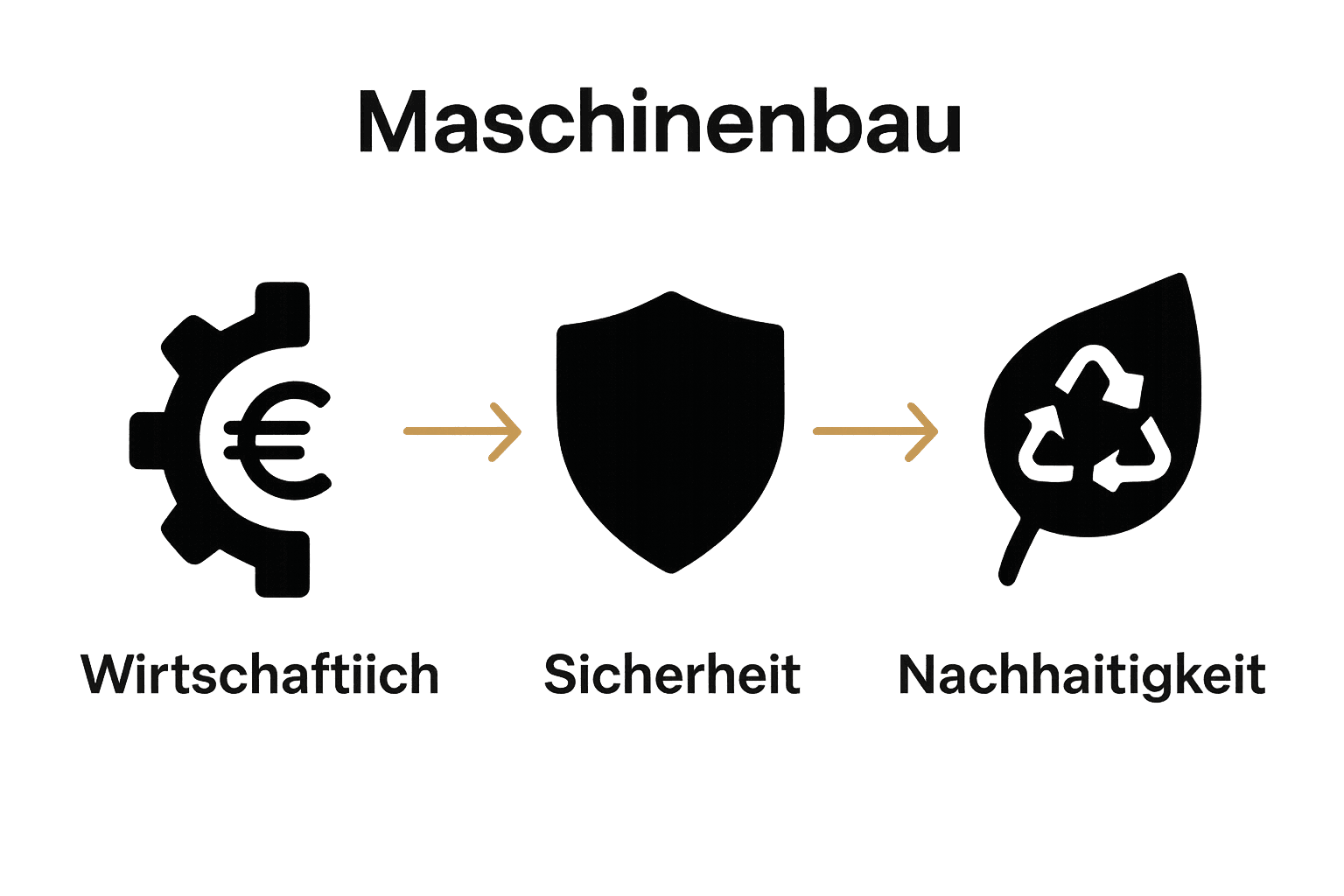
Considering economic efficiency, safety, and sustainability is a central tenet of modern design principles in mechanical engineering. As the Bundeswehr University Munich emphasizes in its 'Design I' lecture, designs today must be developed according to functional, technical-economic, and environmentally friendly criteria.
The most important aspects of this holistic approach include:
- Minimizing life cycle costs
- Reduction of energy consumption and material costs
- Ensuring the highest level of workplace safety
- Development of low-maintenance and durable systems
- Integration of recycling and reuse strategies
Sustainable assembly using reusable aluminum components demonstrates, for example, how modern design principles can intelligently combine cost-effectiveness and environmental protection. The Baust Group emphasizes the importance of durability, low maintenance, and user-friendliness in its design principles.
For engineers, this means thinking far beyond purely technical solutions. It's about developing technologies that not only function, but are also economically viable, safe, and future-proof. The success of modern engineering is measured not only by performance, but also by its responsibility towards people and the environment.
Perfect designs begin with the right components.
The challenge of modern design principles in mechanical engineering lies in creating reliable, economical, and sustainable technical systems. The optimal selection of aluminum profiles, flexible connectors, and precise joining techniques is crucial. Often, high-quality, precisely fitting components that meet these requirements while simultaneously enabling manufacturable implementation and modular construction are lacking.
At Spannwerk, engineers and designers will find a wide selection of industrial-grade aluminum profiles and fasteners for professional mechanical engineering. Our products are specifically designed to intelligently combine material and functional principles to create modular and durable structures.
Take advantage of this opportunity to make your projects more efficient and safer with top-quality components. Visit our online shop at spannwerk.at and benefit from reliable components for all your construction needs. Get started today and take your design principles to the next level.
Frequently Asked Questions
What are the design principles in mechanical engineering?
Design principles are fundamental methods and strategies that engineers and designers in mechanical engineering use to make technical systems efficient and reliable.
Which material and functional principles are important for the design?
Important material principles include the analysis of mechanical properties and the consideration of corrosion resistance, while functional principles concern the transmission of forces and the minimization of energy losses.
How can modularity be used in construction?
Modularity makes it possible to break down complex systems into standardized sub-components, which simplifies maintenance processes and increases flexibility in system adjustments.
What role does design for manufacturability play in mechanical engineering?
Design for manufacturability aims to create technical solutions that can be produced economically and efficiently, reducing overall production costs and ensuring product quality.
Recommendation
- How to plan the perfect substructure for your project – SPANNWERK.at
- Aluminum profiles: Different types and their applications in mechanical engineering – SPANNWERK.at
- Terms and explanations related to aluminum profiles – SPANNWERK.at
- Accessories Guide: Which components should never be used during PV installation – SPANNWERK.at